 Home
 About
 Product
 Tire & Tube
 How to Specify Pneumatic Tire?
 How to Specify Wheel Assembly?
 Wheelbarrow, Hand Truck, Implement
 Lawn & Garden Equipment
 Pneumatic Wheel Assembly
 Flat Free Wheel Assembly
 Curing Bladder
 Tube Valve & Accessory
 Rubber Chemical
 Rubber Machinery
 Contact

To Specify The Pneumatic Tire
|
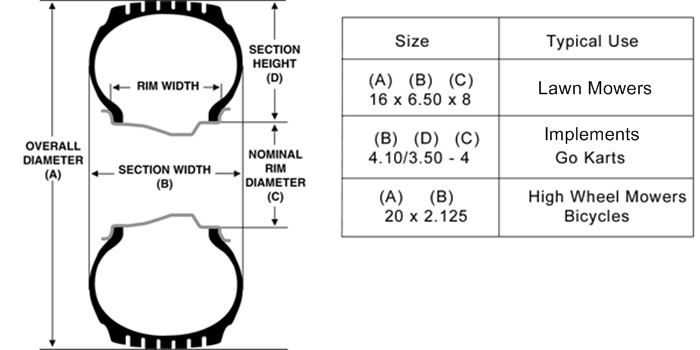
| Size | To understand the sizing of tires is quite easy. There are two popular methods of identifying NHS (not for highway service, usually 5 m.p.h. or less) tires such as those for lawn and garden applications. The first method of designating tire sizes is section width x section height x rim diameter, for instance 4.80/4.00-8. The overall diameter and width is nominal. And the second one is overall diameter x section width x rim diameter. Another example using this method of dimensioning is a 13x5.00-6 tire.
Notice | Since the tire size designations are nominal, tire product developers need to allow up to 8% in variation tolerance. Due to this variance, please be prudently aware of the possibility of tread and dimensional differences while you are selecting tires. It becomes especially important that tire dimensions are critical to influence your product's performance. 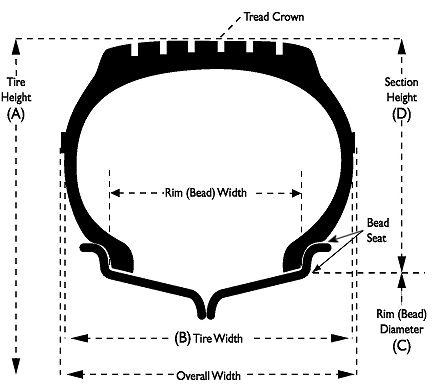 | |||
Explanation
| (A) Tire Height: The full height of an inflated tire when mounted | (B) Tire Width: The distance across an inflated tire at its widest part but not under load. Overall width is including protective decorations or bars (C) Rim (Bead) Diameter: The vertical distance between the upper and lower bead seat (D) Section Height: The vertical distance from the bead edge to center of the crown in an unloaded yet inflated tire (E) Ply Rating: Or described "PR number". Expression of the carcass strength in reference to the number of plies. For example 4 ply equals to 4PR |
Conclusion
| Regarding to the information you can read around the side wall circumference, let's see the following example: |
 |
Home | Privacy Policy | Term of Use | Site Map
|
| Copyright © ARCHSON 2005-2021, All Rights Reserved.
| |